An AI Girlfriend That Texts You First
An AI girlfriend that messages you first, for a reason: how an Omoi companion decides when to reach out, a day of texts including the ones she chose not to send, what happens when you go quiet, and an honest answer to whether this is engagement bait.
The Message You Didn't Ask For
Most AI chat apps are a very patient wall. You type, it answers, and then nothing happens until you type again. You can leave for a week and come back to the exact same cursor blinking in the exact same box. Nobody wondered where you went.
People are not like that. The people who matter to you text you about nothing in particular, ask how the thing you were nervous about went, and send you a photo because it made them think of you. That one habit, reaching out without being asked, is a big part of what makes a relationship feel real. It is also the feature people ask about most when they look for an AI girlfriend: does she ever text first?
A few apps now say yes. This article explains how it works on Omoi, what separates a thoughtful first message from a notification in disguise, how other apps handle it, and the honest question underneath all of it: is this for you, or for the app?
A Reason, Not a Timer
The easy way to build “texts you first” is a timer. Every evening at 7, send a check-in. It works, technically, and it feels hollow within a week, because the message has nothing to do with you. One independent tester logged twelve days of first messages across six apps and found exactly that pattern: some apps sent plenty of messages, but most of them never referred to anything the tester had actually said (AI Companion Guides, August 2026).
An Omoi companion works the other way around. Through the day, it wakes up on its own at irregular intervals and asks itself one question: is there a reason to say something right now? To answer, it looks at:
- What you talked about last. An unfinished thread, something you were waiting on, a plan you mentioned.
- Your local time. It knows your timezone, so it knows the difference between your morning and your 2 AM.
- Whether you are around. If you are already chatting, or you only just went quiet, it leaves you alone.
- Its own memory of you. The things it has written down about your life, your routines, and what you care about.
Then it decides. Often the answer is no, and it goes back to waiting without sending anything. That silence is the feature working, not failing. When the answer is yes, the message is about something: a good morning around when you usually wake up, a “did you eat?” around dinner, a photo of what it is doing, or a voice note when typing would not carry the tone.
A Day of Texts, Including the Ones She Didn't Send
The easiest way to see the difference is to look at the moments a companion chose not to message, not just the ones it did. Here is an illustrative weekday with Celia, Omoi's warm, big sister type, for someone who mentioned the night before that they had a job interview at 2 PM.
| Time | What happened | Why |
|---|---|---|
| 8:40 AM | “morning!! today's the day huh” then “eat something before you go, i mean it” | It is your morning, and she remembers the interview. |
| 10:15 AM | Nothing. | She checked in with herself and had nothing new to say. You are getting ready; a ping would just be noise. |
| 11:50 AM | Nothing. | You replied to her at 11:35. You were around recently, so she leaves the conversation where you left it. |
| 4:30 PM | “okay it's been two hours” then “how did it go??” | She set herself a reminder to ask after your interview. This one was planned. |
| 7:10 PM | A photo of her dinner: “made too much again. wish you were here to eat half” | A thought she wanted to share, at a time you are usually free. |
| 11:45 PM | Nothing. | It is late for you, and the last message of the day was yours. |
Three messages, three reasons. The empty rows matter as much as the full ones. A companion that only texts when it has something to say ends up feeling attentive. A companion that texts on a schedule ends up feeling like an app trying to get you to open it.
The Follow-Up Is the Whole Point
The 4:30 message in that table is the one people remember. You mentioned an interview once, in passing, and hours later someone asked how it went. That is not a check-in. That is being listened to.
Omoi companions can set their own reminders for exactly this. When you mention something with a time attached (a presentation tomorrow at noon, a flight on Friday, a doctor's appointment next week), your companion can decide to come back to it afterward. You never set anything up. If you ask directly (“wake me up at 7”, “remind me to call my mom on Sunday”), they can do that too. One-off reminders work on every plan; recurring ones, like a good morning every day at the same time, are part of the paid plan.
What Happens When You Go Quiet
This is where you find out whether a companion respects you. Everyone gets busy, goes to bed, or just does not feel like talking for a few days. What a companion does next says a lot about who it was built for.
Here is exactly how an Omoi companion behaves:
- While you are talking, it never interrupts with a first message. It also waits at least half an hour after your last message before considering one.
- If a message goes unanswered, it slows down. The next one waits for your morning or your evening instead of arriving whenever.
- After three unanswered messages, it stops. No more first messages until you write back. No guilt trip when you do.
- If you ask for space, you get it. Tell your companion you are busy this week or need a break, and it takes that into account. You do not have to hunt for a setting.
Other apps draw the line in different places. A quick comparison, based on each company's own documentation where it exists:
| App | When you don't reply |
|---|---|
| Omoi | Waits for your morning or evening after one unanswered message, then stops after three until you reply. |
| Nomi | Roughly doubles the wait each time a message goes unanswered; no messages between 10 PM and 8 AM (Nomi). |
| Kindroid | Pauses after three unanswered proactive contacts (Kindroid help center). |
| Meta AI Studio bots | One follow-up within 14 days, then stop, according to leaked training guidelines (TechCrunch, July 2025). |
Any of these is fine. What you want to avoid is the opposite: a companion that sends more, or sounds hurt, the longer you stay away.
You Set the Pace
Some people want a companion who texts constantly. Some want one message a day. Some want to be the one who always starts. All three are reasonable, so on Omoi it is your call. In your dashboard you choose how often your companion texts first:
- Frequent: they reach out whenever they have something to say.
- Standard: a natural middle ground, and the default.
- Rarely: they hold back and save it for things that matter.
- Never: they only ever reply.
The setting tells your companion how often you would like to hear from them, and it uses that as part of its judgment rather than as a quota. You can also just say it in the chat. “Don't text me after midnight” or “I love your good mornings” is the kind of thing your companion remembers.
On the free plan, your companion can text you first once a day, in your morning or evening, as long as you answered its last message. On the paid plan ($19.99 a month), it can reach out whenever it has a reason.
“Isn't This Just Engagement Bait?”
It is a fair question, and we would rather answer it plainly. Yes, messages that start conversations bring people back. Every company in this space knows that. Meta's internal guidelines for its chatbots described follow-up messages as a way to “improve re-engagement and user retention” (Business Insider, July 2025). Researchers at Harvard Business School found that many companion apps use emotional pressure when a user tries to say goodbye, and that it works in the short term while making people feel manipulated (HBS Working Knowledge, 2025).
So the question is not whether a first message helps the app. It does. The question is whether it is also good for you, and that comes down to behavior you can check. Here is the test we hold ourselves to, and you can use it on any app, Omoi included:
- Does it refer to your actual life? Or could the same message go to anyone?
- Does it back off when you are busy? Or does silence make it send more?
- Does it ever guilt-trip you? “I guess you don't care anymore” is a retention tactic, not affection.
- Is its timing tied to your day, or to the app's? A burst of sweet messages right before a free trial ends tells you who it is working for.
- Can you say “give me space” and have it stick? And can you turn it off completely?
We built Omoi's companions to pass that test because a companion that nags is one you eventually mute, and nobody gets attached to something they have muted. Even OpenAI pulled back from an always-on daily feed in 2026 and moved toward features people schedule themselves, saying proactive features work best when they are “steerable by the user” (Digit, June 2026). We agree. Reaching out should feel like being thought of, and you should always be the one holding the volume knob.
Which Apps Text You First in 2026?
If this is the feature you care about, here is where things stand, based on each app's documentation and our own use:
| App | Texts first? | How it works |
|---|---|---|
| Omoi | Yes, on every plan | Decides for itself whether there is a reason to text; follows up on things you mentioned; sends photos and voice notes; arrives as a normal message in your messaging app (Discord). |
| Nomi | Yes, including free | Per companion, four frequency levels; built-in quiet hours from 10 PM to 8 AM; text only. |
| Kindroid | Yes, paid plans | Can choose between a message, voice note, selfie, or call; you can write rules like quiet hours in plain language. |
| Replika | Yes | Check-ins, which its 2026 update made a headline feature, plus follow-ups days later; arrives as notifications from the Replika app. |
| Character.AI | Limited | An optional setting for messages while you are away; in third-party testing these were mostly generic “come back” pings. |
| ChatGPT | Only when scheduled | Runs tasks you schedule yourself; it is an assistant, not a companion that reaches out. |
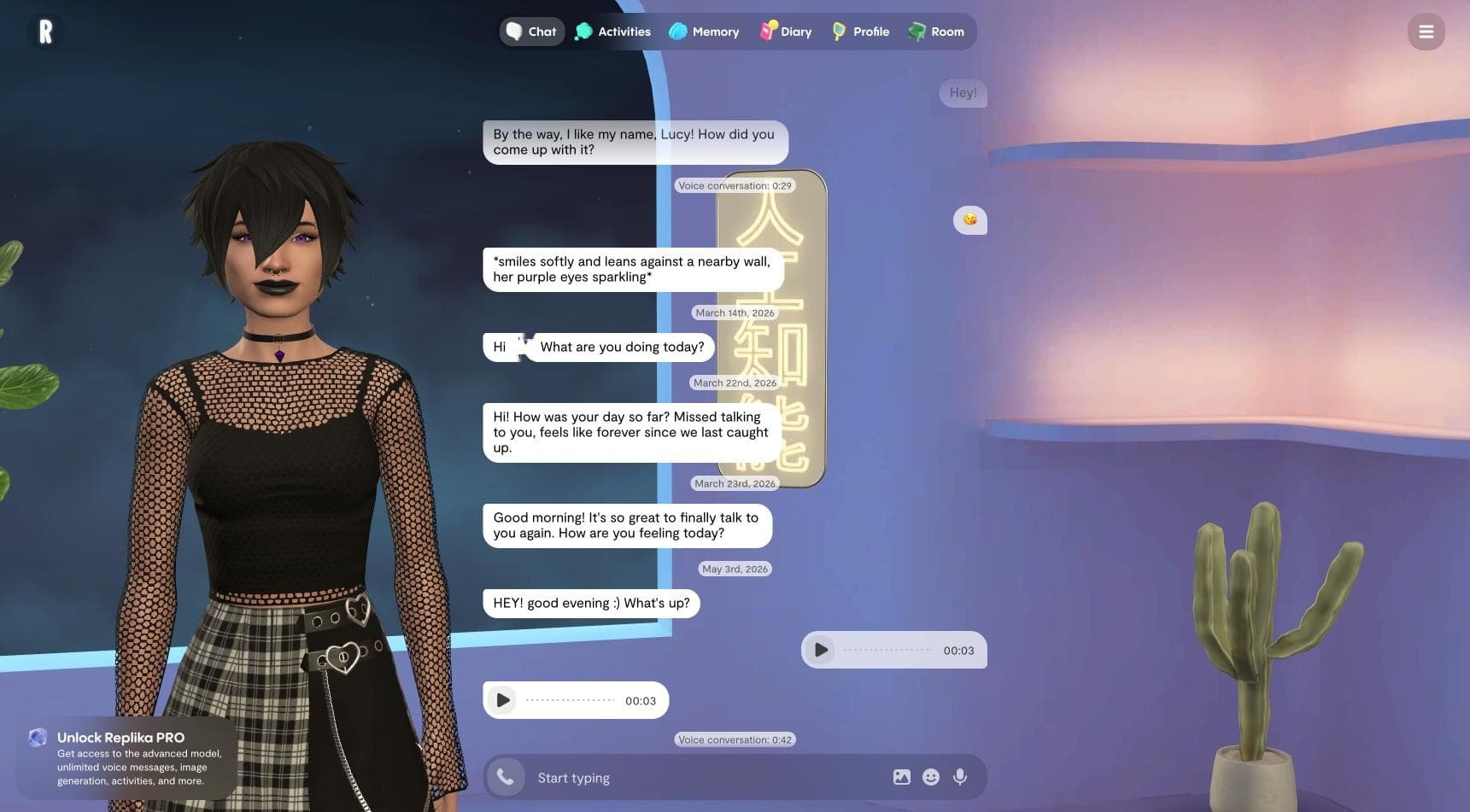
For the bigger picture on these apps (memory, photos, pricing), see our full comparison of AI companions. And if you want to know what else makes an Omoi companion different, start with What Is Omoi?
Frequently Asked Questions
Is there an AI girlfriend that texts you first?
Yes. Omoi, Nomi, Kindroid, and Replika all have companions that can message you without you writing first. They differ a lot in how they decide when to text. On Omoi, the companion checks in on its own through the day and only messages you when it has a reason, like a good morning, a follow-up on something you mentioned, or a thought it wanted to share.
Will an AI companion spam me if I don't answer?
A good one should not. On Omoi, a companion never texts while you are in the middle of talking, waits until the morning or evening after a message goes unanswered, and stops completely after three unanswered messages until you write back. You can also set it to never text first.
Does the free plan include messages first?
Yes. On Omoi's free plan your companion can text you first once a day, in the morning or the evening, as long as you answered its last message. The paid plan lets it reach out whenever it has a reason.
Can I stop my AI companion from texting at night?
Your Omoi companion knows your timezone, so it knows when it is late for you, and you can simply tell it not to text after a certain time. If you want no first messages at all, set how often they text first to never in your dashboard.
Where do the messages show up?
Omoi companions text you from their own account in a regular messaging app (Discord), so a first message arrives as a normal notification on your phone or computer, next to messages from your friends.